It’s hard to understand how Zimbabwe Pro guide training differs from the rest of Africa until you are standing 20 feet away from a giant bull elephant, watching your guide negotiate with the creature on your behalf. There are relatively few Pro-rated guides in Zimbabwe because the training is particularly intense. Learner guides are expected to be able to run a safari camp on their own, be first-aid experts, possess encyclopedic knowledge of animals, and even take down an elephant with their rifle.
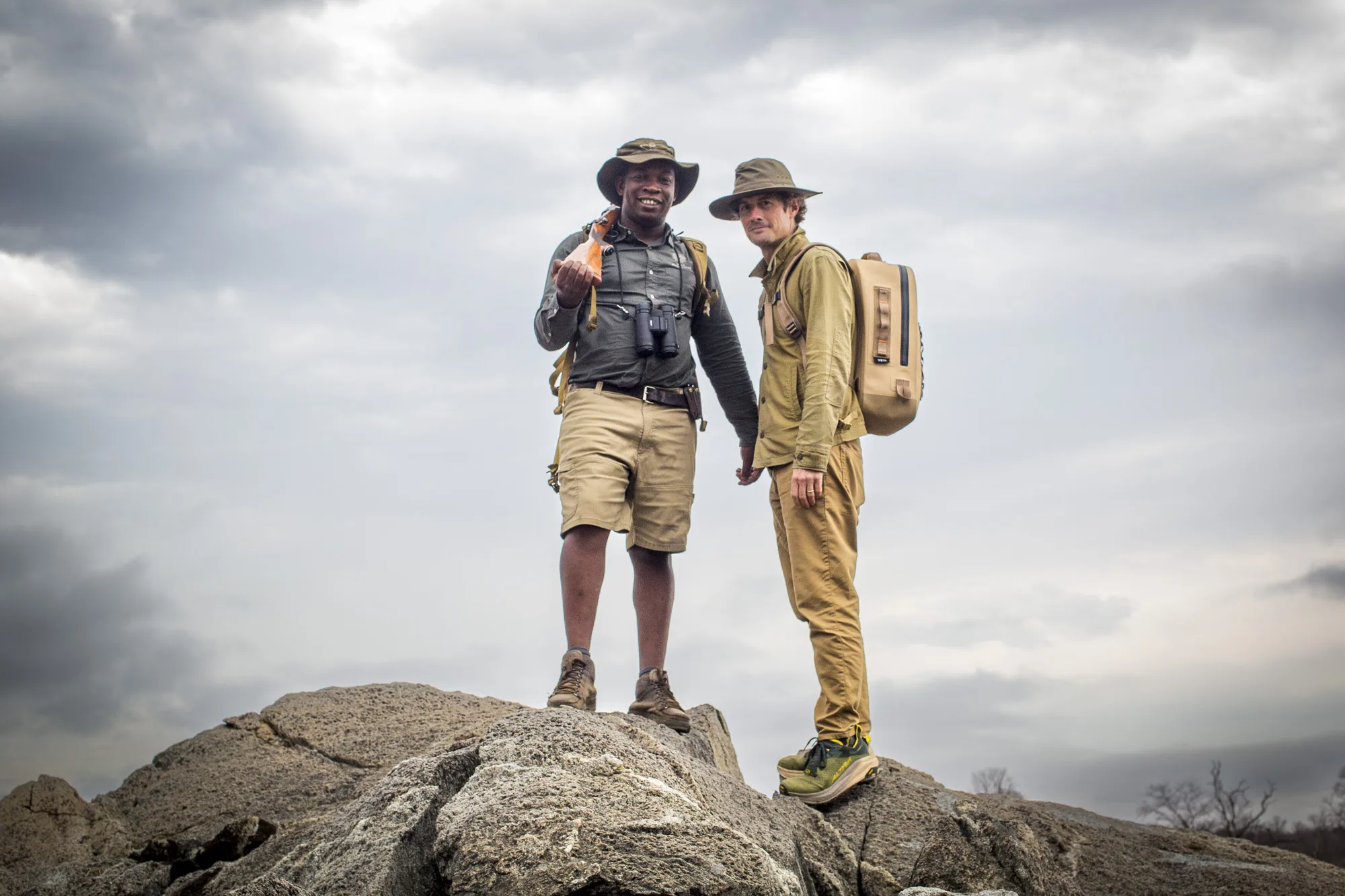
I had the pleasure of being guided by Robert Dube and his apprentice, Con, on my recent trip to Camp Hwange in Hwange National Park, Zimbabwe. In addition to a tour of their private reserve, we also did an incredible elephant approach, which you can see below. It was an unforgettable experience and surprisingly safe in their expert hands. After my trip, I sat down with Rob to talk about his training as a guide and what makes Zimbabwe unique.
Scott Dubois (SD): Hi Rob! To get started, can you tell me a little bit about your background and how you got into safaris and guiding.
Robert Dube (RD): Yeah, so basically, I didn’t have that kind of exposure of being into the safari industry, as a child. We didn’t know much about that. I come from a village that is close to Victoria Falls, which is a tourism village. We used to see those kinds of safari vehicles coming and going, so the inspiration was the car more than the job–haha!
SD: Ha, so when did you get started in safaris? Was there a guiding program or did you get a job in a camp?
RD: Yeah, so basically, in Zimbabwe, to start guiding there’s a theory exam, which has five modules. You can either go to an institute or study for yourself. Then you are actually free to go and take the exam with the Zimbabwe National Parks board.
So I did the studies by myself, and then I went straight to the exam and passed. When you pass that exam, you get what is called a learner guide’s license. This allows you to do game drives, and then you’re allowed to work in camps.
I worked for a different company for a year not being paid; it was more like an internship. So I was doing pretty much everything: I worked as a waiter, I worked in housekeeping, and I did a little kitchen, porter, and maintenance. And learned how to drive in the bush – you know, driving in the bush is different from driving in town! So basically that was the first year of my career, which gave me a very good reference of everything in camp.
Then, I went to Camp Hwange and was employed as a learner guide. That was more like a four-year apprenticeship that I did. During that kind of apprenticeship, you are allocated guests. You can do game drives, but you cannot do walks because you are not a professional walking guide. You’re pretty much learning everything, rifle handling–you buy your own weapon and your own ammunition. You are supplying yourself with books, equipment, et cetera. During those four years, you’re learning walks, marksmanship, how to put up a mobile camp – all aspects you will need.
After four years in Camp Hwange, I wanted to have exposure to different parks, so I did another two years in different parks. Then I went on my final exams in year seven.
SD: Okay, so it was seven years until you were a Pro Guide?
RD: Seven years that took me. The minimum is four years, but for most people it takes longer.
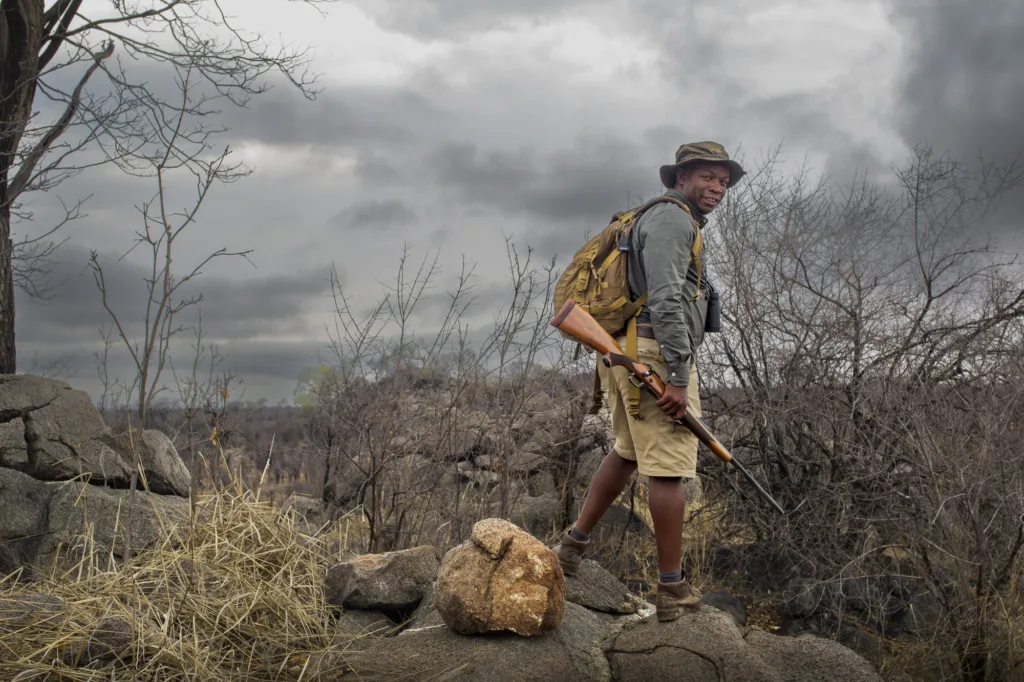
In terms of physique, the training is more like paramilitary because you’re doing long walks carrying bags, marksmanship–you have to be very physically fit.
SD: Okay, wow. The Zimbabwe Guiding program is supposed to be one of the most difficult in the world, but it sounds like you were self-motivated to do it. Is there anything out there to help others do it?
RD: Yeah, so you have to be self-motivated – depending on your background. If you don’t know anyone in the industry, you’re lifting yourself up from scratch, you know? There’s some people that are privileged, whose fathers were guides, so it will be a bit easier for them. They won’t take as much time, but I took seven years to become a pro guide.
SD: What’s the most difficult part about becoming a pro guide?
RD: First of all, is is finding a job; finding a good camp to train you; finding good mentors. And the other part is the financial burden because you are funding yourself, which is very expensive. And the third part is the physical and emotional fitness.
In terms of physique, the training is more like paramilitary because you’re doing long walks carrying bags, marksmanship–you have to be very physically fit. There are lots of dropouts, because they think it’s just driving the car. But there’s more physical work, and work under pressure. Knowledge is not the difficult part. It’s your orientation in the bush, your physical fitness, the way you shoot, the way you behave yourself.
SD: It’s funny because when you were telling me about it, it reminded me of military training – except that you have deep knowledge of plant life and animal life. Speaking of, of the challenges, the one that stands out in my mind is the week at the end of your training where you have to build and operate a safari camp on your own – the final exam. Can you say a bit more about that?
RD: Yes. So basically, you as a guide should know how to manage a camp. So you’re grouped into four or five learner guides and then build a mobile safari camp that can run for seven days.
They just pick any place in the bush and say, “This is where you’re going to build up a camp.” You have to provide the tents, you provide the vehicle, all the plumbing, the water, power, food, fuel. You also hire staff, like the chefs, waiters–everyone. And then you are running a camp for seven days.


SD: And you mentioned the instructors are intentionally difficult?
RD: Yes, for instance, the most important thing is where you put up your camp. They check the safety protocol – that’s number one. Check the fire guards, the first aid – Is your camp safe? Then someone can fake a heart attack during the exam. Or someone can pretend as if he has been stung by a scorpion or bitten by a snake, so they can see how you handle that.
They’re the most difficult clients who are putting you in difficult situations. For instance, on walks, like on that elephant approach we did together. Some guests can be more persistent and say, “Take me closer,” you know? So they can be those guests, they can be so persistent and they want to see if you are going to do it, or if you’re going to say, “You know what? Yeah, just be on this termite mound, because if an elephant comes, this is our safety spot.” So they want you to give them a reason, but they are actually testing you. They’re trying to break you.
SD: Yes. Okay. Just putting you to every test you can imagine.
RD: Exactly. Also, on the knowledge part, they want you to be very, very precise. They will ask you things that you don’t know, wanting to understand how you answer. There are some guys that will make up stuff, so they want to ask you those kinds of questions to see how you handle them and say, “You know what? I’m not sure about this. Maybe I’ll get back to you.” And they expect you to get back to them. If you don’t, then there’s a problem. And they know if you’re making up things. They are very knowledgeable. They have an average of 20 years experience – they have seen it all.
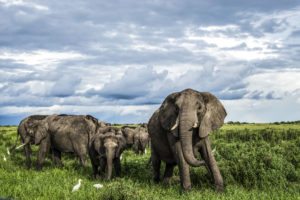
SD: You mentioned our very close up elephant encounter (see video below), which was really incredible. It seems like a challenging situation that you managed very well. Can you say a little bit more about how you handle close encounters and how you’re feeling inside – as far as just staying calm and communicating with the animal and keeping the guests safe all at the same time?
RD: Yeah. So basically, on that encounter, what I was looking at was the body language of the animal. I was looking at his tail; I was looking at how he was feeding. I had also looked at the size and the sex. The older the bulls are more mature–you are able to reason with bigger bulls more than younger ones. They are more wise. And the female elephants are more aggressive than the males. I wouldn’t have done that kind of approach on cows because they are so protective of their calves.
So the other thing–I had a tree and a termite mound, right? And there’s a psychological negotiation between me and the elephant, whereby I know that when he comes, he’s seeing us behind the termite mound– that’s our safety–and he’s not likely to come there.
And then the biggest worry that you have is not about the animal, but it’s about the people behind you. That’s why I constantly talked to guests the whole time. Because you never know. Me, I know what the elephant will do, but, you don’t always know what other people behind you are anticipating. So you have to reassure them that everything is fine.
SD: Okay, that’s fascinating–I hadn’t even thought about that. The elephant is almost more predictable in that situation than some guests might be.
RD: Hundred percent, hundred percent.
SD: How do you learn that? Is it just a matter of experience, or did your mentors take you through situations like that?
RD: Yeah, I had different mentors, and then I was put into many different situations during my apprenticeship, as well as during my exam. So it was both.
Some people will be like, “Yeah, I’ve shot a target.” But when you’re shooting a target, it’s different from when you’re shooting at something that is coming at you.
SD: Most people don’t realize that the Zimbabwe pro guide training involves shooting an elephant. The conservationist in me worries about this. However, it does prove that you can protect a guest if something did go horribly wrong. Can you explain it?
RD: Yeah. So there’s been a controversy about that part. We’re the only country that does that, and others have asked why. You know the walks that we do in Zim are pretty different from the walks that are done in most of the other parts of the continent, right? We track lions, we encounter elephants, we encounter buffalos, so tempers can turn. So if you’ve never done it before, you should never do it for the first time with guests. Some people will be like, “Yeah, I’ve shot a target.” But when you’re shooting a target, it’s different from when you’re shooting at something that is coming at you.
So that’s why there’s a minimum of animals that we take down for PAC. That stands for Problem Animal Control–it’s a nationwide program. Most of our parks are bordered by villages. These people have livestock, they have crops. And elephants do go to their villages and raid crops. It’s a human-wildlife conflict, and according to the rules, if an elephant is outside the park and in the village, we have to take it down. The same applies to buffalos because they can spread foot-and-mouth into the livestock.
As a pro guide, you have a minimum requirement of five animals. You can either shoot three elephants and two buffaloes or vice versa. They want to see if you can do it. This is also another reason why some people can drop out. There are some people that cannot do it.
SD: How is your job changing at all as a guide–is the training evolving at all? How does the future look for Zim guides?
RD: Yeah. So now many lodges are opening which are creating opportunities for the upcoming guides. I’m the first in my generation to own a weapon. I’m the first in my generation to become a professional guide. So it’s a chain that I’ve broken, and now there is more exposure to the opportunity. There are many people who are now hungry who want to do it. It is a good thing because we need more pro guides. And also the old school system was a bit difficult, but we are trying to make a difference by training as many guides as we can.
SD: I believe you said there’s only a little over two hundred pro guides in the country?
RD: Yeah, about two hundred and five now. Which is not much.
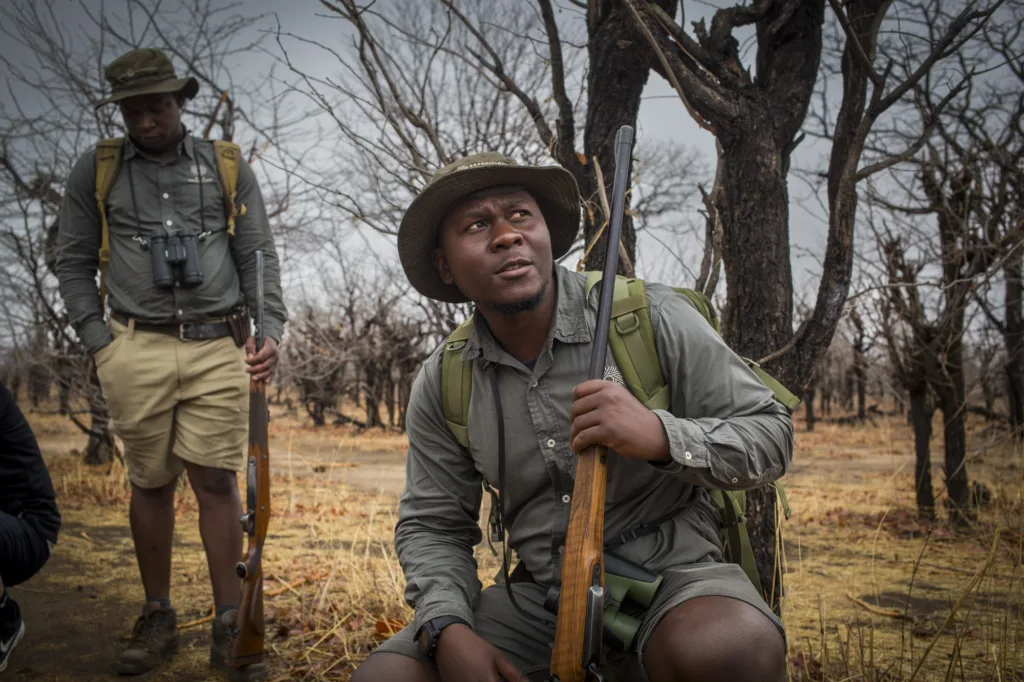
In Zimbabwe, you know, as a professional licensed guide I don’t need a ranger to walk with. I can walk by myself anytime, anywhere. We don’t plan, we just do it. It just flows.
SD: Can you say more about how Camp Hwange and WildExpeditions fits in?
RD: WildEx is a new company with a new brand, and we are trying to make a difference, training as many guides as we can. There’s things that I faced as an apprentice that I’m trying to change. We’re talking to companies and trying to provide resources to our learner guides. At first, some people do drop out because of the economic struggles that we have in Zim. Some people cannot afford training. Now at WildEx, we are trying to give learners at least forty percent of what they require for training.
SD: Okay, that’s good–like a scholarship?
RD: Exactly, and in return, they can pay it back by working for the company for two years or so. So there’ll be a very good succession.
SD: Finally, can you say more to travelers about what makes Zimbabwe unique from a safari perspective?
RD: Yeah, so basically walking plays a very big role in Zim. It’s the thing that makes it more interesting. It’s not a crash course, it’s a lifestyle, so it’s something that you’ve been living with for years. You know, Zim guides are flexible; they’re not robotic. You go with the flow.
In Zimbabwe, you know, as a professional licensed guide I don’t need a ranger to walk with. I can walk by myself anytime, anywhere. We don’t plan, we just do it. It just flows.
We combine expert knowledge with creative itineraries to make your travel dreams a reality. Contact us for a free consultation.

Get monthly travel news, destination guides, and seasonal offers delivered to your inbox.